
[Development Background]
In camping, a wide variety of needs arise depending on the situation. Gathering tools to match those needs is one of the pleasures of camping.
However, carrying specialized gear dedicated to each individual purpose inevitably leads to worse packing efficiency and increased weight. Especially in situations where access is mainly on foot, the "volume" and "weight" of the gear you carry become critical factors that determine your range of action and comfort.
This project adopted an approach of "functional integration"—accomplishing multiple tasks with a single piece of gear. When sitting around a campfire, you want a small side table beside you. While cooking, you don't have enough space to place a cutting board or ingredients. Before packing up, you want a place to hang a few small things. We aimed to create gear that solves all of these "little inconveniences" at once. This reduces the total amount of equipment and, as a result, optimizes "quantity," "size," and "weight."
[Design Points]
- Achieving multiple functions through changes in "form"
- A simple, waste-free design
- Balancing lightweight properties and strength
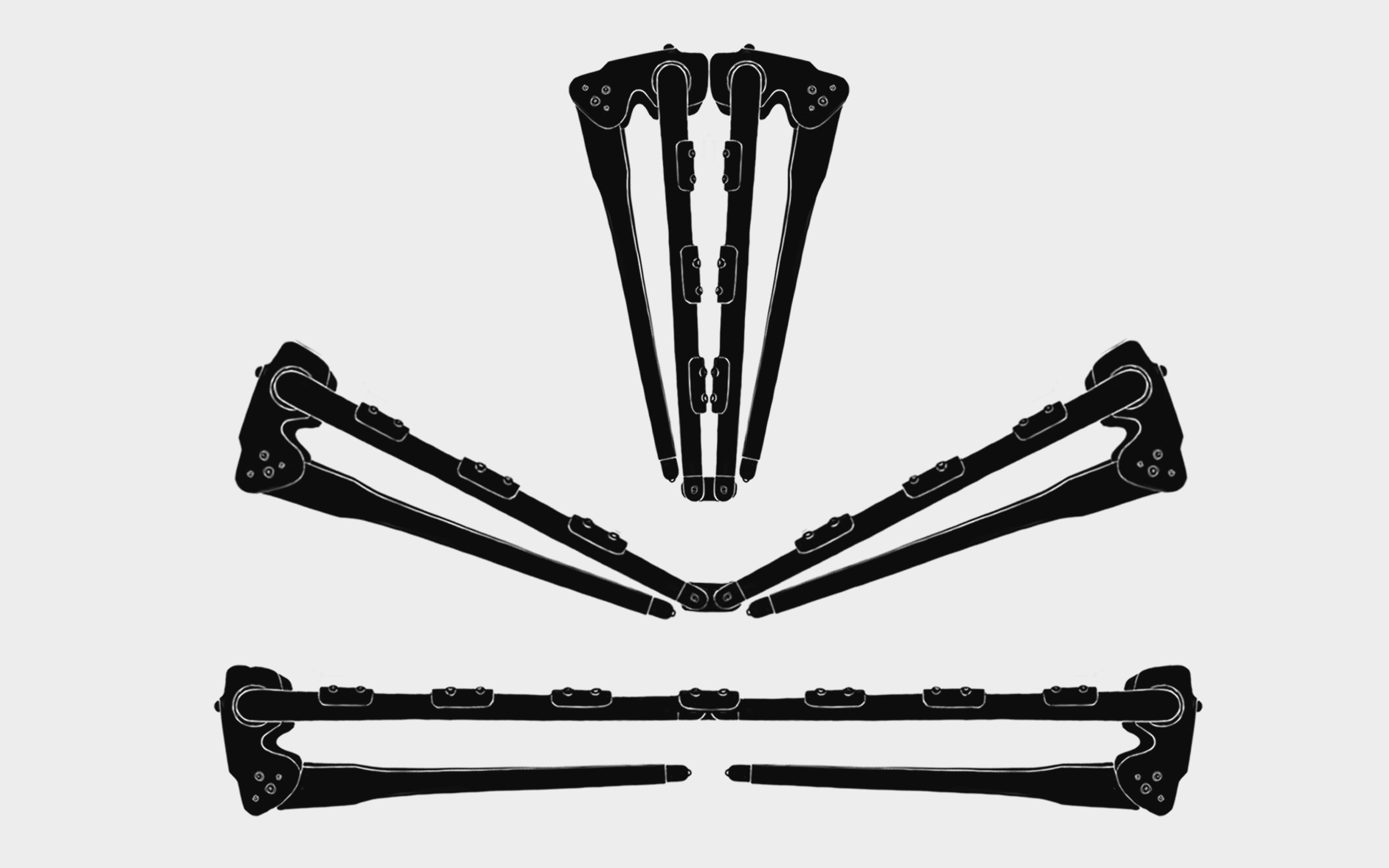
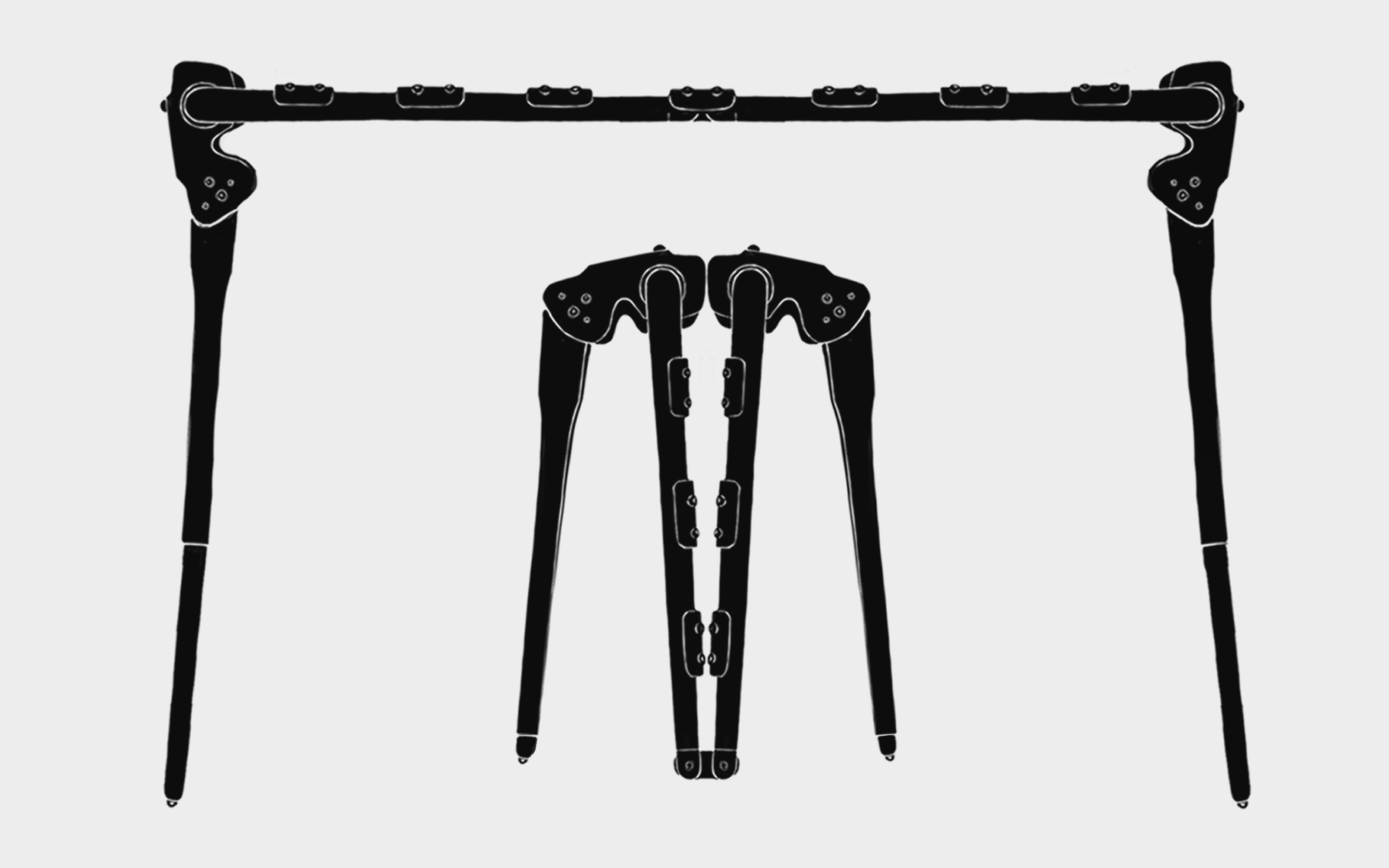
* Some concept ideas
[The Product Development Story]
In the first few months after the project began, we repeated prototyping over and over. But every result inevitably ended up with too many parts and a complex structure. We were supposed to be aiming for a "simple, waste-free form," yet before we knew it, in our eagerness to pack in features, things kept getting more and more complicated. We desperately wanted a simpler "form."
Then one day, we shifted our perspective. What if we stopped thinking of the table as a "board (surface) to put things on" and instead reimagined it as a "frame (outline)" that divides space? If the structure of the frame and the positional relationships between parts could be changed freely, then the way the space within that "frame" is used would naturally change too. If there is no surface, you just place a board on it. If there's something you want to hook onto the frame, you can hook it. If you want to hang something, you can hang it just like that.
This "reimagining the table as a frame"—a shift in thinking that was, in a sense, extremely simple—became the greatest breakthrough in development. The complex mechanisms we had struggled with so much vanished as if they had never existed. The form we should aim for became clear.
The first thing we tackled was optimizing the skeletal structure. We repeated strength simulations many times to identify the points that receive the most force, and improved the design to concentrate strength there. We repeatedly performed structural analysis using 3D CAD to identify stress concentration points. From the perspective of materials mechanics, we derived the most efficient load-distribution structure.


* Photos of the parts
After that, we kept thoroughly reducing unnecessary parts, down to every single component and every single screw. We also reviewed the mechanism of the moving parts from the ground up and repeated prototyping again and again. We adjusted the precision of the machined parts at the micron level, and ultimately completed a mechanism that locks with a reassuring feel and a satisfying "click."
After about eight months and countless prototypes and improvements, the "Multi-function Frame-001" was finally completed. When I held the finished frame in my hands, it was a strange feeling—like meeting a partner who had accompanied me on a long journey. I hope that this "Multi-function Frame-001" will be not merely camping gear, but a "tool" that stimulates the creativity of each and every user.
"Change the frame, and the way you use it changes. Change the way you use it, and the way you enjoy camping changes."
May you be able to head out into the field more freely, without being troubled by heavy loads.
And may the time you spend there be richer and more memorable.
That is all we wish for.